Industrial Raw Material
Eight decades of expertise. From Mangaluru to the world.
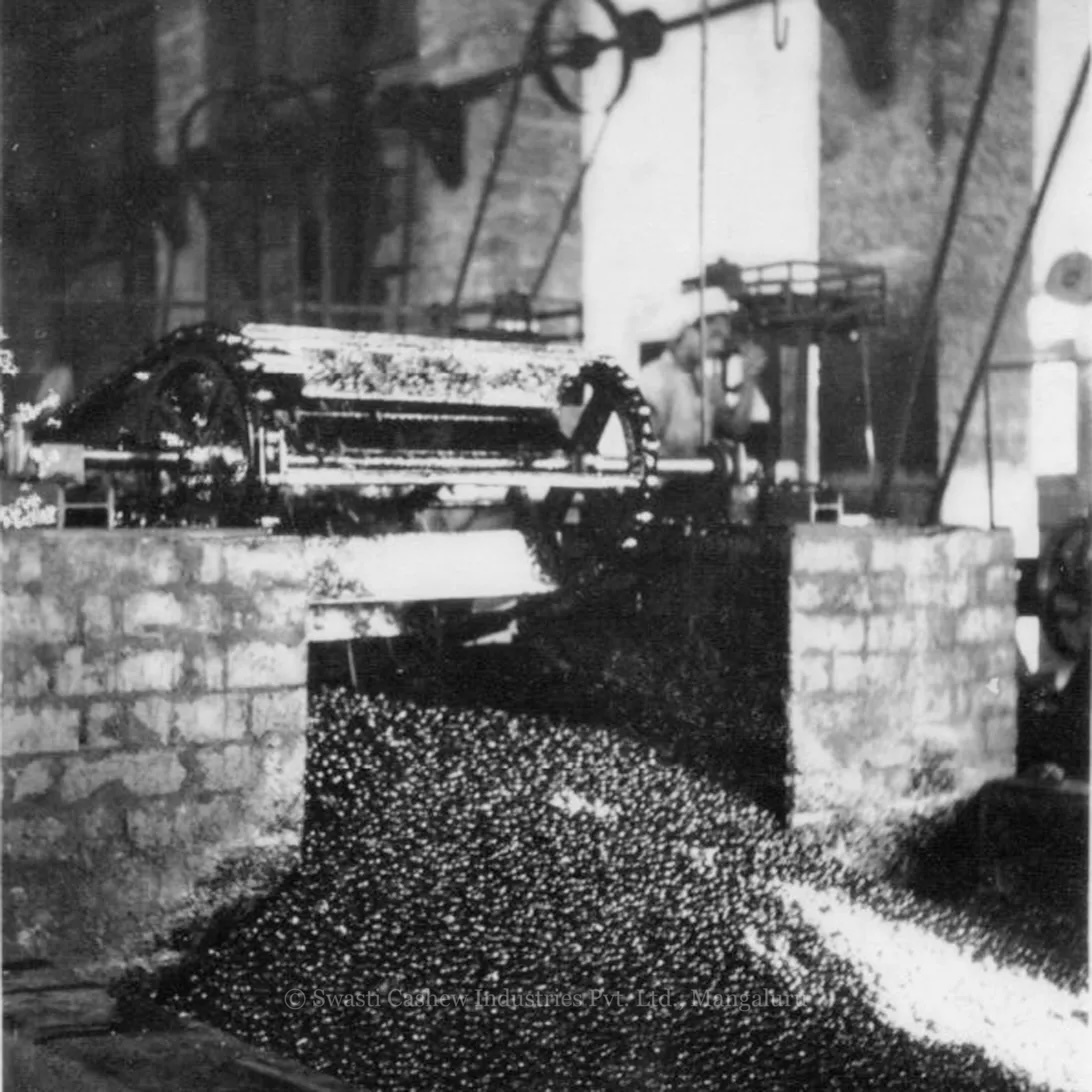
When Shri Sujir Damodar Nayak began extracting Cashew Nut Shell Liquid at his Mangaluru factory in the early 1940s, he was working at the frontier of an industry that had barely recognised what it had. His chemistry degree — earned at the Royal Institute of Science, Bombay University — gave him an understanding of CNSL's industrial potential that most cashew processors of the time did not possess.
By the late 1950s, Swasti Cashew Industries was supplying 400 to 500 tons of CNSL annually to industrial buyers in New York, London and Genoa. The primary buyer was Irvington Varnish and Insulator Co., New Jersey — using it for brake liners, insulating varnish and industrial products.
That depth of engagement — in quality assessment, industrial application knowledge, supply chain and market relationships — is what Swasti brings to the market today. Eight decades is not a claim. It is the record.
The Material
Cashew Nut Shell Liquid is a naturally occurring phenolic compound found in the honeycomb structure of the cashew nut shell. It is one of the few naturally sourced materials that behaves like a synthetic industrial resin — and it has been used as one for over eighty years.
CNSL consists primarily of three phenolic compounds: Anacardic acid, Cardol, and Cardanol — each with distinct chemical properties and industrial applications. The long unsaturated aliphatic chain attached to the phenolic ring gives CNSL its unique combination of flexibility, thermal stability and chemical resistance.
CNSL is extracted during the processing of cashew nuts. The manufacturers and chemists who first recognised its industrial value, and built the expertise to extract, assess, and supply it, laid the foundation for a parallel industrial stream. Swasti Cashew Industries was among them from the beginning.
As industries globally seek bio-based alternatives to purely synthetic compounds, CNSL's natural origin and established industrial performance make it an increasingly relevant material.
Applications
CNSL-based resins are the standard material for brake liners and clutch facings in automotive and aerospace applications. CNSL-modified phenolic resins offer superior thermal stability and consistent frictional performance under the extreme heat conditions of braking — properties recognised as strategically critical during the Second World War and sustained in primary industrial use ever since.
CNSL polymers and condensation products are used as acid-resistant paints, waterproofing compounds, insulating materials and anticorrosive coatings. They combine acid resistance, anticorrosive performance and thermal stability — properties that have sustained their commercial use since the 1940s.
CNSL-modified phenolic resins are used in laminates, foundry applications and surface coatings. The material's natural origin and performance characteristics have made it increasingly relevant as industries seek bio-based alternatives to purely synthetic compounds.
Printing inks, flooring materials, industrial lubricants, and a range of specialty chemical applications all draw on CNSL's unique phenolic properties. Research into new applications continues globally.
Cardanol is the principal industrial derivative of CNSL — obtained through thermal decarboxylation of Anacardic acid during processing. Used in the production of resins, coatings, surfactants, antioxidants and polymer modifiers, its bio-based origin makes it increasingly relevant as a renewable alternative to petrochemical phenols.
Swasti's eight decades of CNSL engagement — from oil bath extraction in the 1940s through bulk tank exports to New York in the 1950s — extends naturally to Cardanol and related derivatives. We work with buyers who value expertise built over generations, not months.
Legacy of Expertise
When Shri Sujir Damodar Nayak began extracting CNSL at his Mangaluru factory in the early 1940s, he was operating at the frontier of the industry. His chemistry degree gave him an understanding of CNSL's industrial chemistry that most processors in Mangaluru at the time could not match.
By the late 1950s, Swasti was supplying 400 to 500 tons of CNSL annually to industrial buyers in New York — most of it shipped in bulk tanks in ships' holds. The primary buyer was Irvington Varnish and Insulator Co., New Jersey, who used it for brake liners, insulating varnish and industrial products. European buyers in Genoa were simultaneously developing as a market.
We are exporting this commodity mostly to U.S.A., where M/s. Irvington Varnish and Insulator Co., New Jersey, are the chief buyers. They use this material for manufacture of brake liners, insulating varnish and other industrial products. In fact, we are shipping 400 to 500 tons of this liquid to New York every year.
That depth of engagement with CNSL — in quality assessment, industrial application knowledge, supply chain, and market relationships — is what Swasti brings to the market today. Seven decades is not a claim. It is the record.
Get in Touch
We welcome enquiries from industrial users and formulators of CNSL and Cardanol, buyers and traders in the CNSL supply chain, companies seeking experienced market guidance, and researchers and industry participants with an interest in CNSL.
Please contact us at info@swasticashew.co.in or call +91 99000 03197.